
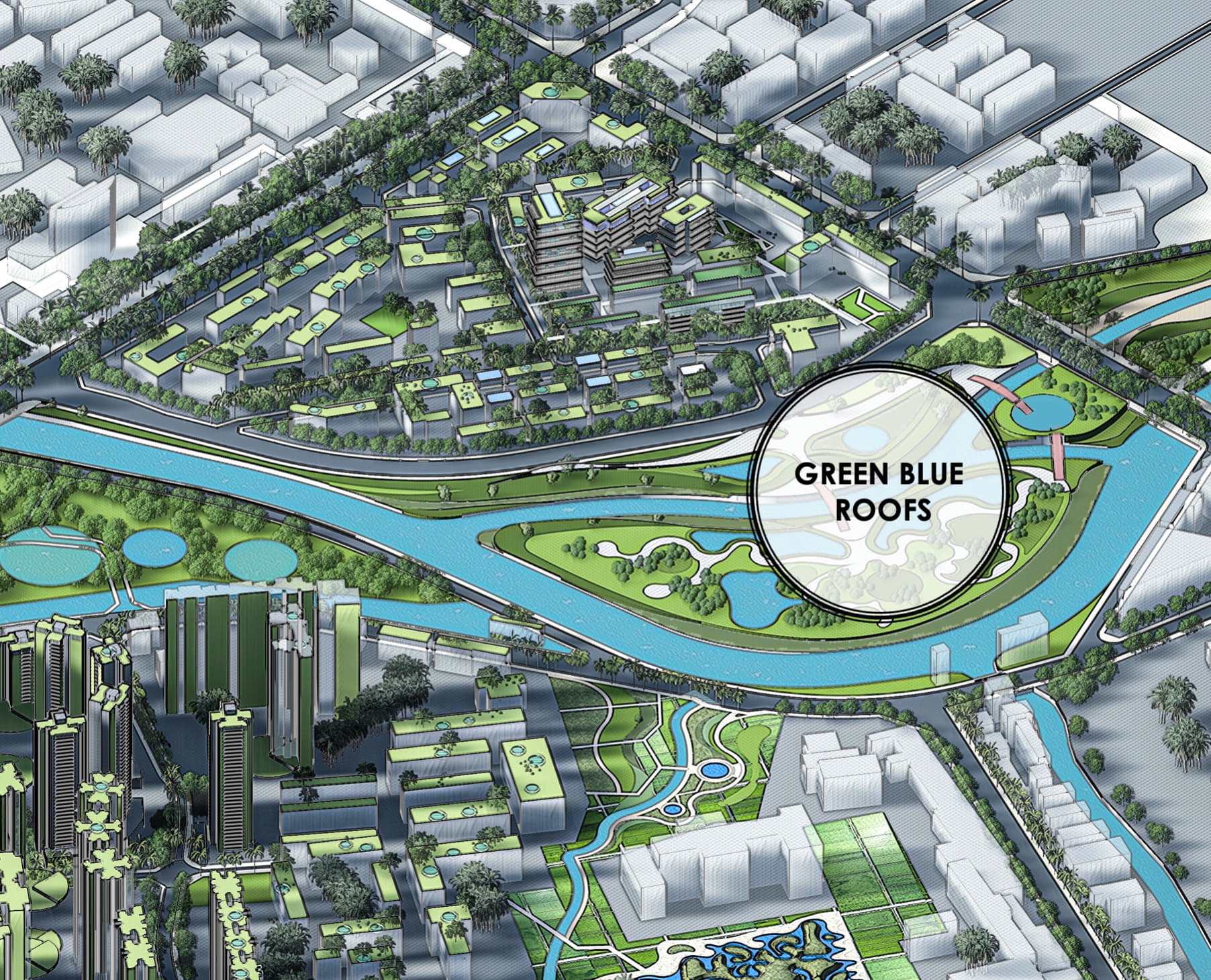
Green & Blue Roofs And Facades

Green and blue roofs, along with vegetated facades can mitigate urban heat island effects and enhance resilience to climate events, as they integrate vegetation layers that provide cooling through evapotranspiration and shade, reducing ambient and building temperatures.

Blue roofs incorporate water retention systems to manage stormwater, effectively mitigating risks from intense rainfall and cloudbursts.

In Southeast Asia, where rapid urbanization, high humidity, and frequent extreme weather events amplify vulnerability to climate impacts, they can support urban farming, enhance biodiversity by attracting pollinators, and host solar panels to optimize energy generation, all while providing recreational spaces for urban dwellers.

These hybrid NbS can also incorporate smart technologies for dynamic water storage management, helping cities to address seasonal flooding. Socially and economically, green and blue roofs can improve urban liveability by creating aesthetic landscapes, reducing energy costs for cooling, and supporting local economies through urban agriculture or green jobs.

Integrating native, drought-tolerant, and water-absorbent plant species that enhance functionality and reduce maintenance needs, green roofs foster climate resilience by promoting sustainable urban ecosystems and increasing community adaptation capacity.


  • Urban heat mitigation
  • Stormwater management
  • Biodiversity enhancement
  • Water cycle regulation
  • Flood resilience
  • Energy efficiency
Flood Control Flood Control
Air Quality Improvement Air Quality Improvement
Urban Heat Island Urban Heat Island

SUPPORTING

  • Habitat creation for biodiversity, including pollinators andA urban wildlife.
  • Soil formation and nutrient cycling through planted systems and organic matter accumulation.

REGULATING

  • Mitigating the urban heat island effect through evapotranspiration and shading.
  • Managing stormwater by retaining and slowing runoff, reducing urban flooding risks.


PROVISIONING

  • Supporting urban agriculture and rooftop farming for local food production.
  • Capturing and storing rainwater for reuse in irrigation or building systems.

SOCIAL BENEFITS

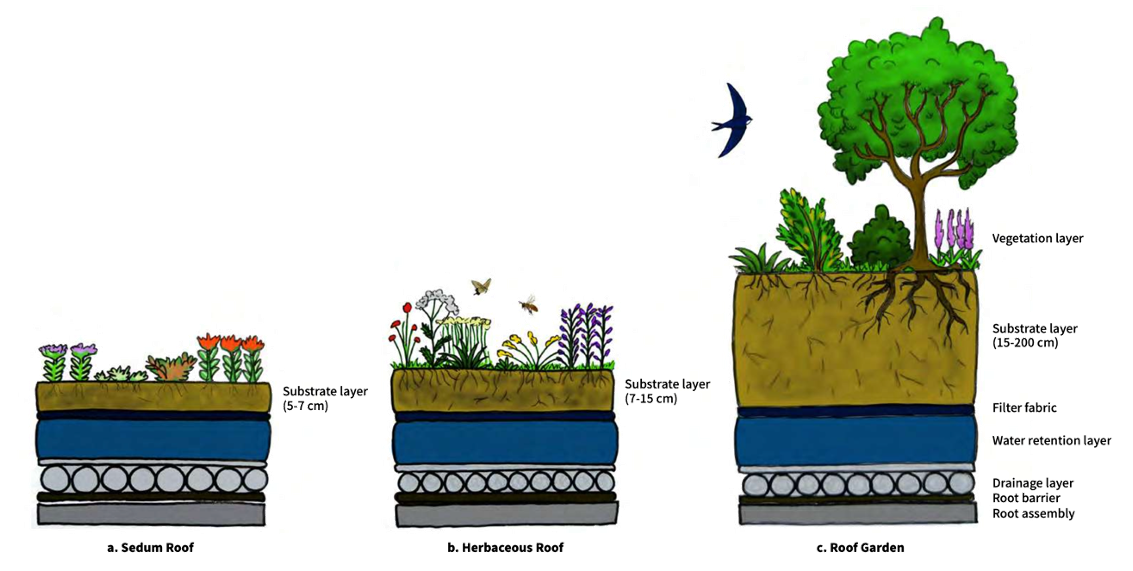
NbS27_Green Roof Layer Scenarios and Functions
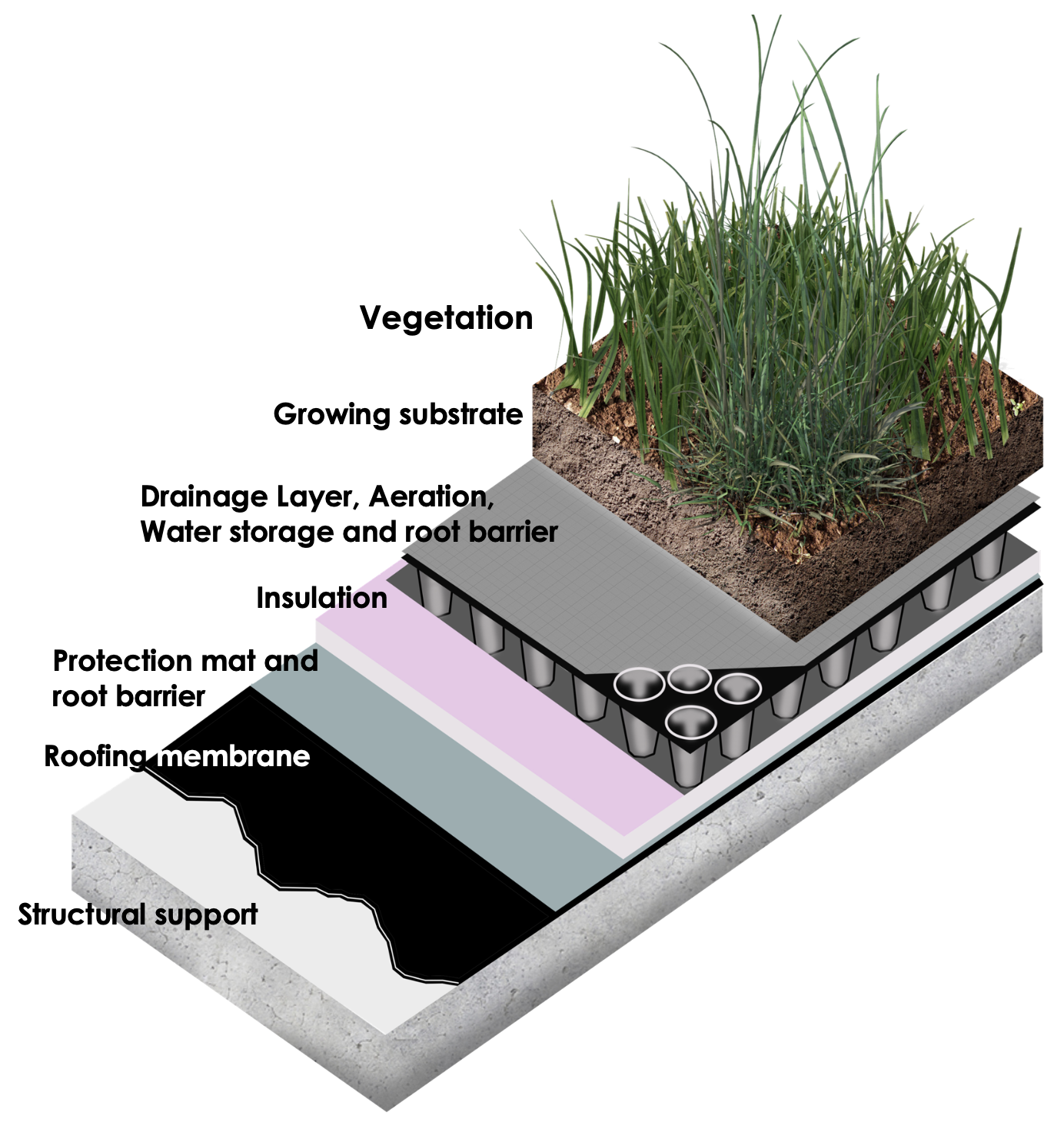
NbS27_Multilayered Green Roof Tech Section with legends

High Maintenance Costs: Regular upkeep, including irrigation, pest control, and structural inspections, can be expensive and resource-intensive.

Structural Limitations: Many buildings in Southeast Asia, especially older or informal structures, may lack the load-bearing capacity to support green or blue roof systems.

Climate-Specific Plant Selection: Identifying and sourcing resilient native plants that can thrive in extreme heat and humidity while withstanding heavy rains can be challenging.

Urban Heat Island Mitigation

Reduction in surface temperatures by 2–4°C, measurable via infrared thermal imaging.

Stormwater Management

Retention of rainfall, monitored through water runoff volume sensors.

Improved Air Quality

Reduction in particulate matter (PM2.5) levels, tracked using air quality monitors near installations.

Biodiversity Enhancement

Increase in pollinator visits and bird species diversity, assessed through regular biodiversity surveys.

Energy Efficiency

Decrease in building cooling energy demand by 10–15%, measured through energy consumption logs.

Social Well-being

Increased use of rooftop spaces for recreation or urban farming, quantified through user surveys and activity counts.

Direct costs

Installation costs range from $75 to $250 /m2 for green roofs and $150 to $400 /m2 for blue roofs.

Indirect costs

Maintenance expenses, including irrigation and structural inspections, typically range from $5 to $15/m2 annually.

Time Horizons

Project lifespan of 20–50 years, with discount rates between 3–7% for long-term sustainability projects in Southeast Asia.

Direct Benefits

Energy savings of $1–$3/m2/year from reduced cooling needs, and stormwater fee reductions ranging from $0.50 to $2/m2/year

Indirect Benefits

Enhanced property values and avoided health costs due to better air quality.

Risk Assessment

structural damage from improper design or maintenance.

REFERENCES

Singapore : Marina Barrage Green Roof 10,000 m2 rooftop garden and Kampung Admiralty, vertical urban village.

Netherlands, Smart Green-Blue Roofs of Resilio Project, Amsterdam.

IMPLEMENTATION OPPORTUNITIES

Jakarta: Menteng and Sudirman areas.

Metro Manila: Quezon City and Makati.

Bangkok: Sukhumvit and Silom.

Cambodia, Phnom Penh: Tonle Bassac, BKK1.

Myanmar, Yangon central urban districts: Dagon Township.